


Can you give us an overview of your business and how you started it?
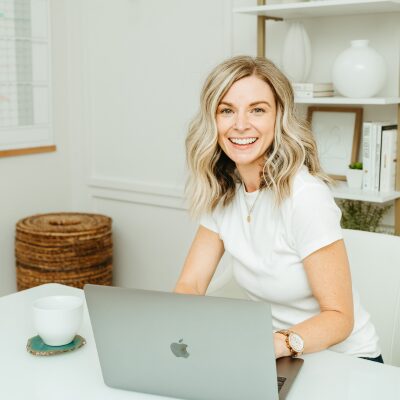
The overview of the business today is very different than how I started it. I started in 2017 after being laid off from my corporate job. I hold a master’s degree in marketing and have spent nearly a decade in corporate marketing. I was applying for jobs and realized during an interview that I didn’t want another job. I pitched myself as a consultant on the spot. I called my husband and told him, “I think I want to start a business.”
So the business started with marketing consulting, and then I realized I wanted to work with women entrepreneurs. That led to a big pivot when I wrote my book. I started writing in 2022, was published in 2023, and through that process, I realized I didn’t want to teach marketing anymore. Now I help women who want to make big changes, start a podcast, write a book, scale out of their business. I call myself an accountability coach, but it’s really about navigating change and making hard transitions.
What would you say your favorite thing is about being a business owner?
Hands down, it’s the flexibility with my time. My “why” is really simple. I hated submitting PTO requests. I didn’t want to count hours just to take off the week between Christmas and New Year’s. That’s my deep reason. When things get hard, I think, “Do I want to submit a PTO request again?” and the answer is no.
How has the evolution of your business aligned with your purpose or life stage?
That’s such a good question. I believe my purpose/my legacy is to encourage people. That’s what I was put here to do. Whether it’s helping someone start a business, encouraging my stepkids before a test, or talking to you today, I’m here to encourage. It shows up in everything I do.
What would you tell someone who’s unsure if they need an accountability coach?
There’s a theory on changing behavior (The Transtheoretical Model (TTM) of behavior change): pre-contemplation, contemplation, action, and maintenance. I don’t work with people in pre-contemplation—they’re not ready. I want to work with people who are ready and just need the right support. If you’re not ready for change, coaching won’t work. If you’re contemplating change and seeking support, that’s when I can help.
I have also created categories including personal, peer, and paid. Personal is self-driven. Peer is like a running buddy. Paid is when you invest to move forward. I help people understand which type works best for them.
Have you gone to an accountability coach or life coach before starting your business?
Not before starting this business. Since 2018, I’ve had a variety of support: mentors, paid groups, and a book coach while writing my book. I’ve done programs to learn how to create curriculum and joined different coaching structures depending on what I needed at that time.
Do some personalities get stuck in specific phases of the change cycle?
Yes, definitely. Some can get stuck in the action stage or other stages. Personality affects how people move through those stages. Some people thrive with group coaching, others need one-on-one courses and DIY resources.
You describe accountability coaching as transformational. What inspired your signature “Momentum Method”?
Great research question! It came from reflecting on all the clients I’d worked with. I reviewed years of coaching notes and saw patterns.
Even though I was “teaching marketing,” I was really helping people navigate change.
That’s how I developed the three key components of the Momentum Method:
- Clarity – Know what you want?
- Capacity – Understand your current resources: time, money, energy, knowledge.
- Commitment – Be honest about what you can truly commit to.
That’s what gives people permission to say either yes or not right now.
How do you help clients through breakthrough moments using the Momentum Method?
One recent client has a team of nearly 100 employees, but she couldn’t let go of day-to-day tasks. She told me she “loves information,” but I reflected back: “It sounds like control more than curiosity.”
That moment realizing it was about control gave her clarity.
These moments happen a lot. Clarity is often the game-changer. Capacity is usually math. I even built a capacity calculator with AI to help clients see how many actual hours they have.
I saw on your site that 93% of clients hit their 90-day goal. What are the biggest barriers women face during that time?
Great stat, right? Most hit a roadblock between Day 10 and 14. I anticipate it. They start strong, then hit that wall.
By Day 60, many feel they’ve made no progress so I help them reflect and see the wins.
Barriers include:
- Overcommitment (especially with time)
- Lack of self-discipline
- Underestimating mental load
That’s why I use the capacity calculator to show: You don’t really have 90 days—you may only have 37 when you subtract obligations.
You’ve launched a business, podcast, and book. Which felt most aligned with your purpose?
The evolution of my business has been authentic every step of the way. Each launch felt aligned, but I’d say the book was the most exciting because it was so different. That said, I also loved launching the new podcast. I’m a marketing person I enjoy launching.
Were you a writer growing up?
No! I never thought I’d write a book. But in 2017, I told myself, “If I’m ever in a position to give information the way I’ve received it through books, blogs, and podcasts I will.” That led me to start my podcast in 2019 and write my book in 2022.
How does the storytelling process differ between podcasts and writing a full-length book?
Storytelling is something I work on all the time. I study it, because I’m not naturally concise. When I prepare for podcasts, I get very intentional about the message and try to cut extra words. Writing the book required more structure and discipline in how stories were laid out. It’s a different process, and I’m still learning.
I’m naturally wordy, so I’ve studied storytelling a lot.
With podcasting, it’s about clarity and efficiency. I talk to one person. For video, I used to write a name (like Megan, an early client) on a sticky note and talk to her. That helped me be more personal.
Writing the book required much more structure, editing, and brevity. I didn’t reuse podcast content, it was all fresh.
Did the editors work with you while writing or only afterward?
Both! My structural editor worked with me during the first draft. I wrote a lot, and she helped put it into a structured format.
Then came the developmental editor, who made sure the ideas flowed. The other three editors came in later, once we had a solid draft to refine it further. The final round focused on marketing, specifically identifying which parts to highlight for promotion.
Were you involved in the marketing process yourself?
Oh yes, very much so. Probably more than most authors.
When you’re sharing stories—especially funny ones—how do you balance personality with clarity?
I bring personality in when I share stories, especially if they’re funny. But I make sure the call to action or message is as clear as possible using the least amount of words. That’s really important in a podcast setting.
For the book it was totally different. I had five editors help me reach the final stage. Brevity isn’t my strong suit, so having that team made the stories stronger.
I thought I’d just repurpose podcast content for the book, but I ended up writing all new material.
What would you say to pessimists to encourage them to be more optimistic or to just feel better about themselves?
Use your strengths! Being more cautious or skeptical is valuable. People like me, optimists, can sometimes miss important risks. Pessimists balance that. They are prepared and thoughtful, which is a strength. Lean into what comes naturally to you. That’s what I tell all my clients.
Can you share a personal story where you had to build discipline, and are you naturally disciplined
Absolutely. Content creation especially podcasting was hard at first. I had to build the muscle of consistency.
At the start, no one listened. I got excited over 12 views on YouTube and two were me!
To push through, I imagined I was talking to Megan, one of my first clients. I literally wrote her name on a sticky note next to my camera. I reminded myself: If I can help one person, it’s worth it.
Yes, being disciplined is a strength of mine. But it can also be a flaw. Sometimes I’ll stay committed to the wrong thing for too long. I need people to help me step back and ask, “Is this still worth doing?”
You’re a wife, stepmom, and business owner. How do you protect your energy across roles?
I don’t do it perfectly. But I do my best with the information and resources I have.
I’ve learned that if I carry work energy outside this office, my relationship suffers.
So at the end of the workday, I use a closing ritual:
- Review my “today list” (not a to-do list)
- Reassign unfinished tasks
- Say, “I did enough.”
- Shut the door and leave the office.
When the kids lived at home, I didn’t take calls after school. I wanted to be available, even if they didn’t come in. I do the same with friendships now and protect my time with people.
What advice would you give someone who has big goals but feels too busy to read or listen to long podcasts?
I’d go back to the Momentum Method:
- Clarity – What do you want?
- Capacity – What season are you in? What’s realistic?
- Commitment – What are you willing to commit to even when it gets hard?
Even small, consistent steps (like 10 minutes of writing or walking a day) add up if you stick to them.
I can’t guarantee goal completion on a specific date, but I can guarantee progress if you have those three components.
What’s next for you? Any exciting projects?
Yes, this research project is my big focus. I’m developing tools to help people understand how they get stuck based on their personality and what to do next.
Instead of just saying, “Well, it depends,” I want to offer actual strategies.
For example, If you’re an INFJ, maybe you tend to overthink. So I would like to provide the best way to get unstuck for you through my current research.